„Oh no, I’m not a teacher.“ Das betone ich im Zusammenhang mit meiner Arbeit im Goethe Institut immer wieder. Und trotzdem bin ich am Ende in ziemlich vielen Schulen gelandet. Nicht als Lehrerin. Und auch nicht als Botschafterin für Deutschland. Ich habe über meinen Alltag gesprochen: Wie ich zur Schule gegangen bin und studiert habe, was ich wann, wie und mit wem meistens so esse und trinke, was es im Jahr zu feiern und zu bedenken gibt und wann man frei hat von Arbeit/ Studium/ Schule. Später wurden daraus Philosophie-Vorlesungen an den drei größten Senior Colleges, aber das ist ein anderes Thema. Jetzt geht es um meine „Landeskundewochen“ in Punes High Schools und Junior Colleges. In denen, die Deutschunterricht anbieten und zu dem PASCH-Netzwerk gehören.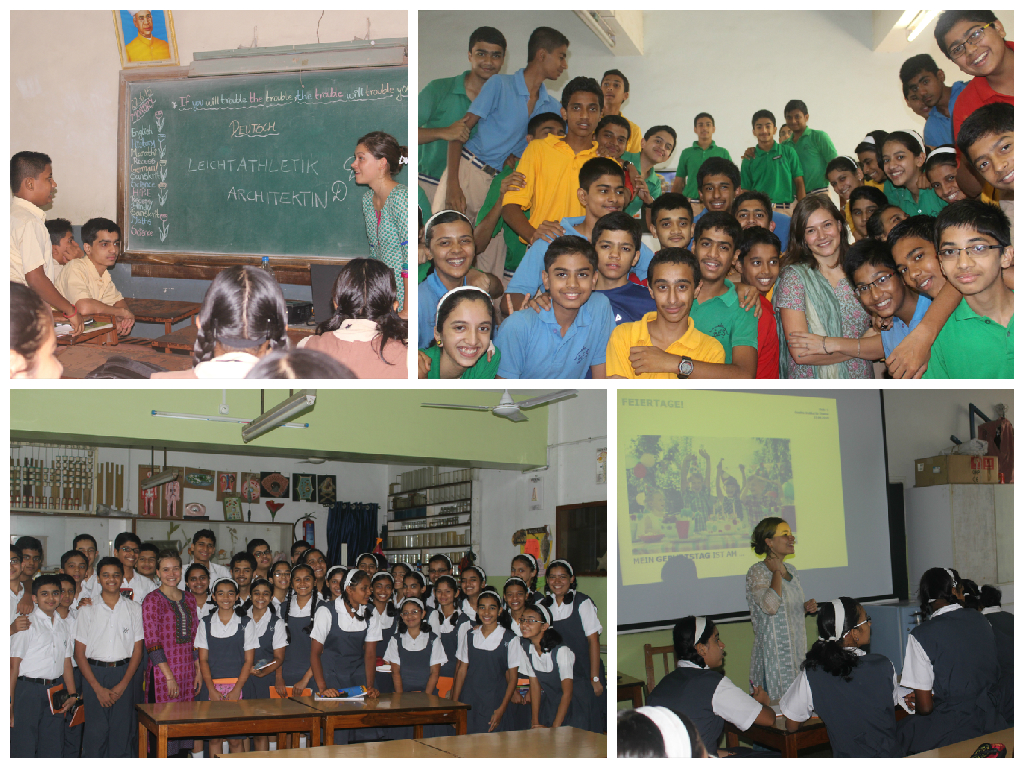 Mit vielen Fotos, Vokabeln und Anekdoten im Gepäck verlasse ich das Institut also für ein paar Tage. Meine Erfahrungen, die ich als Neuling in Pune gemacht habe, sollen mir dabei helfen, von meinem vorherigen Alltag in Europa zu sprechen. Dann heißt es Stimme ölen und Beamer an. In gut 40 angespannt-aufgeregte Gesichter schauen und erstmal die Stimmung lockern. Landeskunde ist für eine Studentin trans- und postnationaler Denkansätze nicht gerade das Gelbe vom Ei. Aber Schwarz-Weiß-Denken hat auch noch keinem weitergeholfen. Unter den sperrigen Begriff der Landeskundewoche fällt somit für mich die Chance, Klischees aufzubrechen, Befürchtungen und Unverständnis genauso wie übermäßiger Bewunderung entgegenzuwirken. Und bei allen guten Vorsätzen hat mich die Wechselseitigkeit und Vermischung von Erklärungen und Beschreibungen „indischer“ und „deutscher“ Dinge am Ende doch vom Hocker gehauen. Für all die Aha-Momente und Lachanfälle ist hier nicht genug Platz. Den möchte ich hier einer weiteren Autorin für den Blogbeitrag widmen. In der ehemaligen Schule meiner Arbeitskollegin und Freundin sind mir eine Handvoll Dinge aufgefallen, die mich ziemlich verdutzt haben. Ich habe sie danach gefragt und wenige Tage später folgenden Text bekommen. Außerdem sehr passend: Morgen ist Independence Day!
“India is my country. All Indians are my brothers and sisters”
The clanging rhythmic sound of a gothic bell marks the commencement of a typical school day in India, and all the students line up in their uniforms just like tweedledum and tweedeldee on the school playground for a school assembly, which is a bigger deal in Indian schools, probably bigger than changing of guards at the Buckingham palace in London! Now we don’t just line up, there is a system to it, we line up class wise, grade wise, gender wise and just so that the taller students feel an inch taller, height wise, back to back with a one hand distance. So after repetitive desperate announcements by the supervisor over the microphone to make order, the assembly finally commences with a formal “good morning students, stand up straight for the national anthem”. After a patriotic start up, comes the school’s attempt to invoke ideals of fraternity amongst its pupils, so we repeat after the school prefect, who stands proud on the dais, the pledge “India is my country, all Indians are my brothers and sisters”, thus envisaging the future of a peaceful utopia!
After listening to important announcements and applauding the achievements of our kith and kin, the assembly is dismissed and we troop back to our classrooms, again class wise, grade wise, gender wise and height wise. If you are having a rough day, or if your arch enemy happens to be one of the “health monitors”, then there is a fair chance that you might be pulled out of the line for not having polished shoes or for having long, unclean nails, loose socks or a chic haircut, but on the plus side, if you have made friends with the health monitor, then you might get away with the latest trendiest nail polish or a short pinafore showing off your bare knees.
The classrooms in a typical Indian school, given the net population of the country, are basically crowded. We have on an average about 55 students in a class. If you walk in as a guest to an Indian school classroom, don’t be astonished if all the students sprang up from their benches and recite in a sing song voice “Good morning sir/teacher and namaste”. The classrooms mostly have wooden/ metal benches for two, which are personalized by carvings of the most interesting drawings, name initials and sometimes the most difficult formulas to save one from failing in a geometry test! In school, the carvings on the benches are innocent; a little village amidst mountains, the drawings get raunchy on college/university benches, showcasing whole different kinds of mountains!
If you are in a co-ed (co-education) school in India, you share the bench with a partner of the same sex. It is mostly two boys then two girls, and if the school has less trust in its pupils, then it is alternating rows of girls and boys. In an Indian school, you are not allowed to choose your bench partner, it is chosen for you, by the class teacher. The idea being, you make new friends, but now when I think of it, it is strategic, just so that you talk less and the class remains quiet, thus sparing the teacher from shouting on top of her voice!
So basically the school toils to make its students a bunch of obedient, ambitious and virtuous citizens of the nation, but that is also the main purpose of a “school”, although every country has its own way of doing oder wie die Deutschen es so schön sagen würden: ,,Jeder macht sein eigenes Ding.’’
– von Etisha Botre